


Electricity meters and power meters are frequently seen in daily life and industrial production, playing an indispensable role. However, many people often regard them as the same type of device, thinking they are just different names. This is not the case. Although they are both closely related to electricity metering, they differ significantly in definition, principle, function, application scenarios, and technological development. Understanding these differences is crucial for both ordinary consumers to make informed choices about household metering devices and for businesses to accurately monitor industrial electricity consumption. Let’s unveil their mysteries and explore their differences.
Strictly speaking, an electricity meter is an instrument that accurately measures the electrical energy consumption in a circuit. It acts like a meticulous “electricity manager,” presenting precise data on the user’s electricity usage. Electricity meters not only record electricity consumption over a period of time but also possess many “hidden skills,” providing rich electrical parameter data such as voltage, current, power factor, active power, and reactive power. This data is of paramount importance for power system operation monitoring, energy management, and analysis of rational electricity consumption by users. With its powerful functionalities, electricity meters are widely used in various scenarios, including residential buildings, industrial plants, commercial complexes, and public facilities, adapting to the electricity metering needs of different environments. In the current era of booming smart grids, electricity meters play a crucial role in intelligent interaction, enabling efficient data transmission and interaction with users and the power supply system, thus contributing to the optimal allocation and rational utilization of energy.
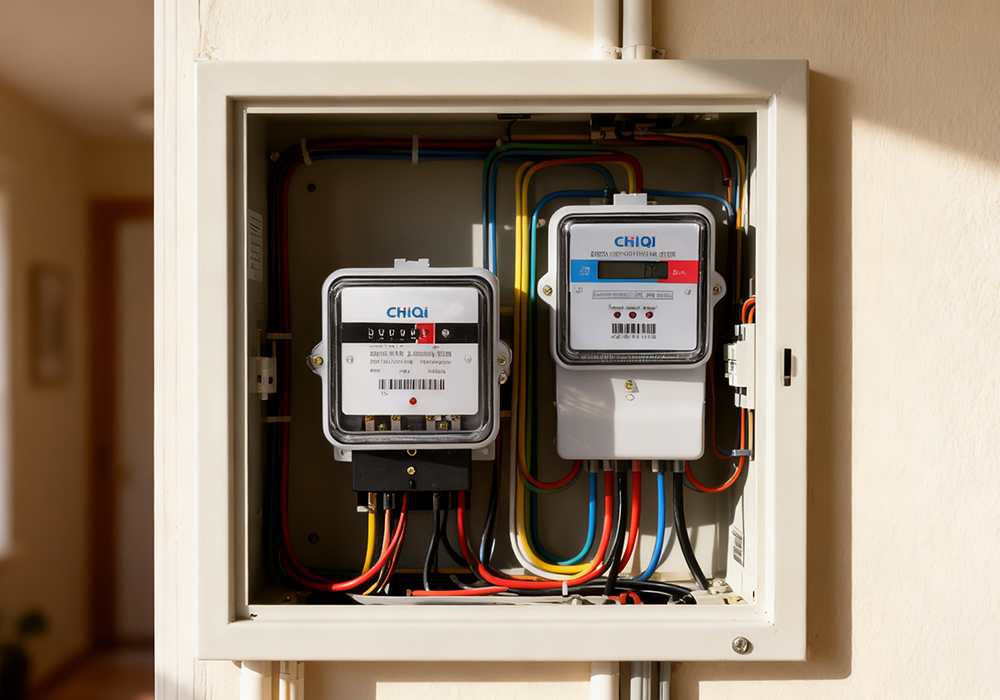
The electricity meters we commonly refer to, in a narrow sense, are more often the traditional mechanical electricity meters, the kind commonly found in early homes and small businesses that measure electrical energy through a rotating disc. Their working principle is relatively simple, primarily utilizing electromagnetic induction to convert electrical energy into the mechanical rotation of the disc. The number of rotations is used to measure energy consumption. These meters have a relatively simple function, mainly focusing on measuring the total amount of electricity consumed by the user, measured in kilowatt-hours (kWh), providing basic data for electricity billing. Due to their simple structure and low cost, they were the primary tool for electricity metering in ordinary households and small businesses for a long time. However, with the rapid development of technology, the limitations of traditional electricity meters in terms of function and accuracy have become increasingly apparent, and they are gradually being replaced by more advanced electricity meters.
With their powerful functions and high-precision measurement capabilities, electricity meters have become the preferred choice for large-scale electricity consumption and complex scenarios such as industrial production lines and power systems. In industrial production, electricity meters act like precise “power stewards,” capable of meticulously monitoring and analyzing the energy consumption of each production stage. For large factories with multiple production lines, electricity meters can measure the electricity consumption of each line separately. By analyzing the electricity consumption data of different time periods and different equipment, enterprises can accurately grasp their energy consumption. Based on this data, enterprises can rationally arrange production plans, increase production load during off-peak hours, make full use of low-cost electricity resources, and reduce production costs. Electricity meters can also promptly detect energy waste in the production process, such as equipment running under no-load or abnormal power parameters, and remind staff to take measures through alarm functions to avoid unnecessary energy consumption. In the power system, electricity meters play an indispensable role, serving as an important basis for power dispatch and management. By measuring the energy consumption at each node of the power grid, power departments can monitor the grid’s operating status in real time, rationally allocate power resources, and ensure the safe and stable operation of the power grid. When the power grid experiences a fault or abnormal load, the data provided by the electricity meter can help power maintenance personnel quickly locate the problem, repair it in a timely manner, and ensure the continuity of power supply.
Electricity meters, especially traditional meters, are typically standard equipment for measuring electricity consumption in homes and small businesses. In a home setting, the meter acts like a silent “little electricity guardian,” simply and directly measuring the total daily electricity consumption. Whether it’s common appliances like lighting fixtures, televisions, and refrigerators, or high-power appliances like air conditioners and water heaters, the meter accurately records their energy consumption. By reading the meter readings, users can clearly understand their household’s electricity usage over a period of time, allowing them to plan their electricity usage accordingly. During peak summer electricity consumption periods, users can consciously reduce the usage time of high-energy-consuming appliances based on the meter readings, or choose to use these appliances during periods of lower electricity prices to reduce electricity bills. For small businesses, such as convenience stores, barbershops, and small restaurants, meters can also meet their basic electricity metering needs. These small businesses have relatively simple electricity usage patterns, mainly focusing on lighting, small electrical appliances, and some simple processing equipment. The meter accurately measures their electricity consumption, providing businesses with a clear basis for electricity bill settlement. Compared to large industrial enterprises, small commercial users have relatively lower demands for power parameter monitoring and energy management functions, and the basic metering functions of traditional electricity meters are sufficient to meet their daily operational needs.