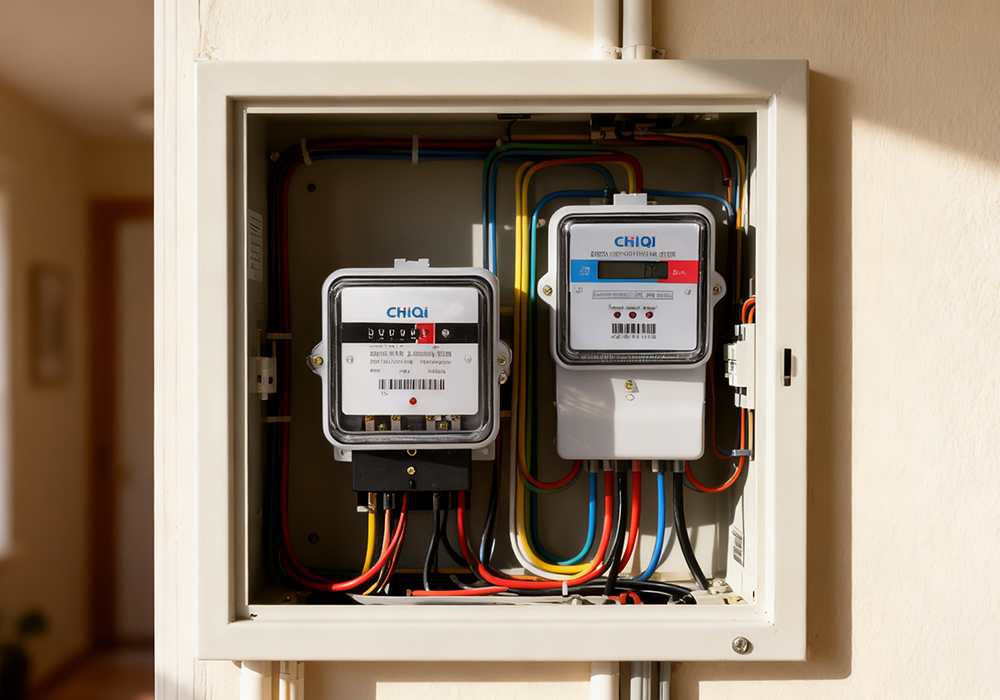



The working principle of an electricity meter incorporates advanced digital technology, much like a master of precision measurement using high-tech methods. During operation, it first uses high-precision sensors to sample the current and voltage in the circuit in real time, converting these continuously changing analog signals into discrete digital signals. Next, the digital signals are transmitted to an internal microprocessor or dedicated metering chip, where powerful data processing capabilities are utilized. The chip performs a series of complex calculations on the acquired digital signals according to specific algorithms, such as correcting and calculating the measurement results, and compensating for errors caused by changes in temperature, frequency, and other factors, thereby achieving high-precision measurement of electrical energy. Taking a common smart electricity meter as an example, it can be accurate to multiple decimal places, accurately recording every bit of electricity consumed by the user, providing extremely accurate data for electricity billing. In the industrial field, some high-precision electricity meters achieve astonishing levels of measurement accuracy, meeting the extremely high requirements of production scenarios for electricity metering.
Traditional electricity meters, also known as kilowatt-hour meters, operate based on the classic phenomenon of electromagnetic induction, much like an old craftsman adhering to traditional techniques. They primarily consist of an iron-core current transformer and an electromagnetic voltmeter. When current flows through the current coil and voltage is applied to the voltage coil, an alternating magnetic flux is generated in the iron core. This alternating magnetic flux passes through an aluminum disc, inducing eddy currents in the disc according to the principle of electromagnetic induction. These eddy currents experience a force in the magnetic field, causing the disc to generate torque and begin to rotate. The greater the power consumed by the load, the greater the current flowing through the current coil, the larger the eddy current induced in the disc, and the greater the torque on the disc. The rotation of the disc drives a counter, and by accumulating the number of rotations, the energy consumption is measured. However, the measurement accuracy of this type of meter, based on the principle of electromagnetic induction, is affected by the voltage and current waveforms. When harmonics or voltage fluctuations exist in the circuit, the measurement error will increase accordingly. In early power systems, due to the relatively simple electrical equipment and stable grid waveforms, traditional electricity meters could adequately meet metering requirements. However, with the development of modern industry and the widespread application of various nonlinear electrical devices, the harmonic content in the power grid has increased, making it difficult to guarantee the metering accuracy of traditional electricity meters in such an environment.
Electricity meters boast a wide range of functions, much like a skilled all-rounder. Beyond their core function of accurately measuring energy consumption, they possess a series of powerful extended functions, providing users with comprehensive power monitoring and management services. In terms of electrical parameter monitoring, they can monitor the power factor in real time, allowing users to clearly understand the energy utilization efficiency of the circuit and adjust electrical equipment in a timely manner to improve energy efficiency. The monitoring function of current harmonics is also crucial. With the widespread use of various non-linear electrical devices in modern industry, harmonic pollution in the power grid is becoming increasingly serious. By monitoring current harmonics, electricity meters can promptly detect potential power quality problems, ensuring the stable operation of the power system. Regarding data processing and storage, electricity meters are equipped with large-capacity data storage devices that can store a large amount of historical electricity consumption data. This data is like a detailed electricity consumption log, recording the user's electricity consumption at different times, providing strong data support for users to conduct electricity consumption analysis and formulate energy-saving strategies. Taking smart electricity meters as an example, they can not only store daily and monthly electricity consumption data, but also record peak and valley electricity consumption information at different times. In terms of communication and interaction functions, electricity meters typically have multiple communication interfaces, such as RS485 interfaces, infrared communication interfaces, and wireless communication modules. Through these interfaces, electricity meters can interact with power management systems and smart home devices. Using the RS485 interface, the electricity meter can transmit real-time electricity consumption data to the power company's meter reading system, enabling remote automatic meter reading and significantly improving efficiency and accuracy. With the wireless communication module, the electricity meter can also connect to the user's mobile phone or computer, allowing the user to check their electricity consumption anytime, anywhere and set electricity usage reminders through a corresponding app or software. The electricity meter also has an alarm function; when it detects abnormal voltage, overload current, or low power factor, it will promptly issue an alarm to remind the user to take appropriate measures to prevent equipment damage or safety accidents.
In contrast, traditional electricity meters have a relatively simple function, primarily focusing on basic energy metering. They function like a single-task executor focused on its core function: accurately measuring the total amount of electricity consumed by the user. By counting the rotations of a dial, the meter converts energy consumption into intuitive numbers, presented to the user in kilowatt-hours (kWh), providing reliable data for electricity billing. In early power systems, due to the relatively simple nature of electrical equipment and the limited needs of users for electricity information, traditional meters, with their simple and reliable metering function, met the basic requirements at the time. However, with technological advancements and increasing demands for electricity management, the functional limitations of traditional meters have become increasingly apparent. They generally lack the ability to monitor other complex electrical parameters and cannot provide users with important power quality information such as power factor and current harmonics. Traditional meters also have significant shortcomings in data storage and communication; they lack large-capacity data storage to store historical electricity consumption data and effective communication interfaces, making it difficult to achieve data interaction with external systems and remote meter reading functions. Traditional electricity meters fall short when users want to access more detailed electricity usage analysis or participate in smart grid applications such as electricity demand response.