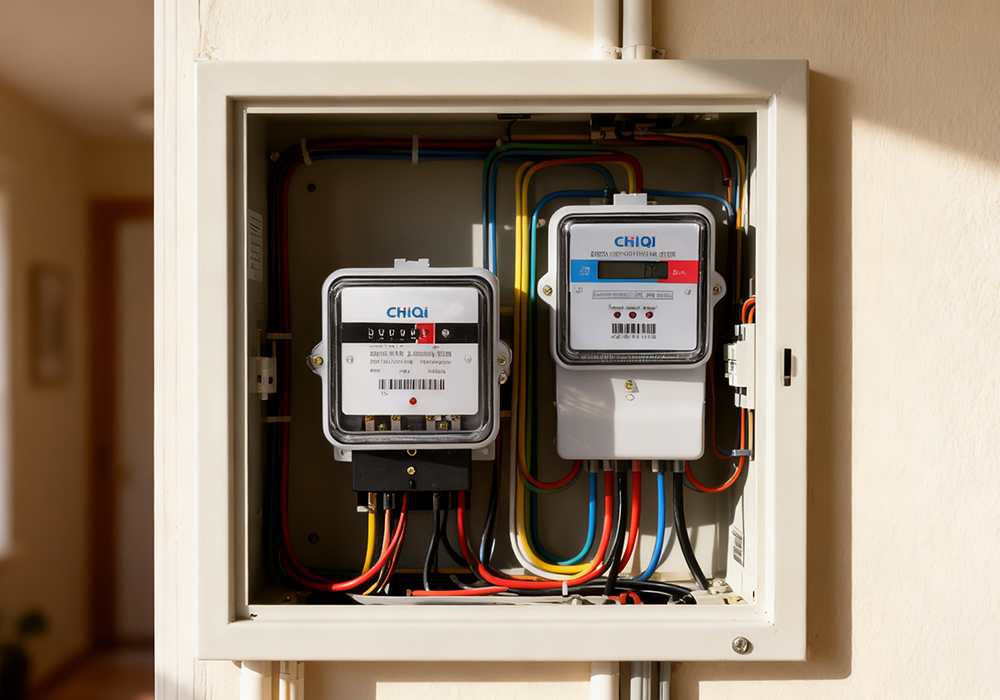



The purpose of factory retrofits using smart meters isn't simply to simplify meter reading. Instead, they transform invisible energy consumption into quantifiable, analyzable, and controllable energy-saving opportunities through five key approaches: precise measurement, real-time monitoring, anomaly identification, policy optimization, and data-driven approaches. Smart meters aren't just "energy-saving devices," but rather the cornerstone of achieving energy conservation.
1. Make energy consumption visible – no data, no energy savings
The first step to saving energy is to know where the energy is being consumed.
Traditional factories only know the total electricity consumption, but not:
Which device consumes the most power?
Which workshop has the highest standby energy consumption?
What is the ratio of peak to valley electricity consumption?
Smart meters are installed in layers and items on main lines, key equipment, and branch circuits to achieve:
Independent measurement for each production line and each team
Air compressors, central air conditioners, lighting and other systems are counted separately
Automatic recording of time-sharing electricity (peak, flat, valley)
Only with these data can we accurately locate the "electricity tigers" and provide targeted targets for energy conservation.
2. Discover "Invisible Waste" - How You Don't Know How Electricity Is Lost
Many factories waste electricity due to "normal operation". Smart meters can identify these "invisible killers":
Standby energy consumption: Equipment is shut down but the power is still on, such as an injection molding machine running at heat or an air compressor running idle. One factory discovered that a piece of equipment was consuming 8kW of standby power, which translates to 192 kWh of electricity over a 24-hour period.
Non-production electricity usage: Lighting and air conditioning left on after get off work, or illegal use of high-power appliances. The system analyzes nighttime electricity usage and automatically issues an alarm.
Inefficient operation: Motor aging and transmission system wear lead to decreased efficiency, increasing current but maintaining output. Smart meters identify anomalies through power trends.
These wastes are usually invisible, but may amount to hundreds of thousands of kilowatt-hours of electricity a year.
3. Optimizing Electricity Usage Strategies: From “Extensive Electricity Usage” to “Careful and Calculated”
With data, we can formulate scientific electricity utilization strategies:
Peak-valley electricity price management: Arranging high-energy-consuming processes (such as electroplating and smelting) during off-peak hours can save 0.3 to 0.5 yuan per kilowatt-hour.
Load balancing: Through three-phase current monitoring, unbalanced loads can be detected, equipment allocation can be adjusted, and line losses can be reduced.
A food factory saved 15% of its annual electricity bill by adjusting the operating hours of its refrigeration system, which is equivalent to earning an extra piece of equipment.
4. Support remote control - automatic execution of energy-saving strategies
Smart meters are not just “eyes” but also “hands”:
Scheduled power off: Set policies, such as automatically cutting off non-essential power (lighting, office equipment) at 10 pm.
Remote power off: If abnormally high power consumption is detected, the power can be cut off with one click in the background to prevent further losses.
Prepayment control: The power supply in the tenant's workshop will be automatically cut off when the electricity fee is paid and restored after payment, eliminating waste.
These controls transform energy saving from “relying on human reminders” to “automatic execution by the system”, with more lasting effects.
5. Data Feedback Management: From “Experience-Based Decision-Making” to “Data-Driven”
Energy saving is not a one-time thing, but a process of continuous optimization. Smart meters provide long-term data support:
Energy efficiency benchmarking: Calculate unit product energy consumption (kWh/unit), compare different teams and different equipment, and identify best practices.
Energy-saving effect verification: Compare electricity consumption before and after the transformation to quantify energy-saving results for internal assessment or application for government subsidies.
Predictive maintenance: By analyzing current and power change trends, the aging of equipment such as motors and transformers can be predicted, and maintenance can be performed in advance to avoid inefficient operation.
An electronics factory optimized the start-up and shutdown sequence of SMT production line equipment through data analysis, saving 120,000 yuan in electricity costs annually.